UEFA has threatened an unprecedented boycott after a leaked plan suggested FIFA could sell stakes in the World Cup through a new commercial vehicle, a move that would shift control and profits toward private investors, deepen rifts between European federations and FIFA, and force urgent talks over governance, competition format and who truly owns the game.
Leaked plan: FIFA proposes selling World Cup stakes
A leaked proposal has reignited a governance storm in world football by outlining a plan to sell minority stakes in the World Cup via a new commercial entity. The blueprint envisages a vehicle—described as FIFA Forward Enterprise—that would consolidate commercial and event operations and allow private investors to take minority positions while FIFA retains majority control.
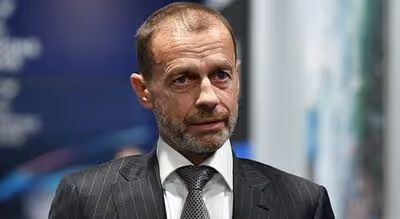
The documents suggest all 211 member associations would be allocated small equity parcels—reportedly around $20 million each as part of a 20% collective stake—with the option to sell those shares. Banks and financiers are said to be involved in structuring the deal, and a handful of high-profile investors have been linked to the discussions.
UEFA reaction: emergency meeting and boycott threat
UEFA reacted swiftly and angrily, calling the idea a crossing of a line and signalling a potential emergency meeting of European associations. The governing body warned that national federations, leagues, clubs, players and fans should all treat the move with the utmost seriousness.
That response has escalated to talk of a boycott of FIFA tournaments, potentially as soon as next year’s Women’s World Cup in Brazil. The mere possibility that World Cup holders and European heavyweights—Spain, England and France among them—could decline to participate marks a severe escalation in the institutional dispute.
FIFA’s public position: commercial growth versus governance concerns
FIFA has publicly acknowledged plans to launch a controlled subsidiary to consolidate its commercial and event activities, asserting that it would retain exclusive authority over governance, competitions, the match calendar and regulatory decisions. The organisation frames the initiative as a mechanism to increase funding for member associations and to professionalise the commercial arm of the game.
Yet the plan also raises immediate questions about conflicts of interest. Proposals discussed in the leaks include senior executives or former presidents taking lucrative executive roles in the new structure—an arrangement critics argue would blur the line between charitable governance and private enterprise.
Political and stakeholder backlash
The reaction has not been limited to football institutions. Former and current figures across the sport have condemned the proposal as a sale of a public asset. Political voices have framed it as a fundamental betrayal of the game's custodianship by administrators, while former officials have warned that close personal ties between leadership and political actors intensify concerns about transparency and motive.
What it means for competitions and the calendar
If implemented, the commercialisation model could reshape global football’s calendar and competitions. Options on the table discussed in the leaks include expanding or increasing the frequency of the Men’s and Women’s World Cups, and reimagining the Club World Cup—moves that would have downstream effects on domestic leagues, player workloads and broadcast revenues.
For federations, the immediate offer of capital from selling allocated stakes might look attractive on paper—especially for associations with limited annual income—but it could also trade long-term voting power and cultural ownership of tournaments for short-term liquidity.
Impact on clubs, players and fans
Clubs and players stand to be collateral in any calendar changes. Increased frequency or expansion of global tournaments risks fixture congestion and greater load on elite players, while a shift toward investor-friendly scheduling could clash with domestic priorities. For supporters, the key fear is commodification: that the World Cup becomes a packaged asset rather than the sport’s communal, cultural pinnacle.
Governance and trust: the deeper issue
Beyond commercial mechanics, the episode exposes a deeper governance crisis. When those who regulate the sport also helm potentially lucrative commercial platforms, conflicts of interest and accountability gaps become inevitable. The prospect of senior officials moving from ruling roles into commercial positions connected to assets they once controlled will intensify calls for structural safeguards or legal scrutiny.
Next steps and likely outcomes
Expect immediate political and institutional manoeuvring. UEFA’s emergency talks could result in a formal rejection or negotiated safeguards. Member associations must decide whether to accept equity allocations, sell them for immediate funds, or hold out to protect sporting sovereignty.
Legal and regulatory questions may follow, and national governments could enter the debate if boycotts threaten major events or public interest. At minimum, the leak guarantees intense scrutiny of any formal proposal, and it forces FIFA to validate both the commercial logic and the governance protections around any new entity.
Why this matters
This is not just a financial restructure; it is a contest over who owns football’s flagship tournaments. The answer will shape the sport’s future revenue flows, competitive calendar and public legitimacy. If administrators prioritise private capital over collective stewardship, they risk alienating the very communities—fans, players and national federations—that give the World Cup its global meaning.
Martinez and Mac Allister hire private security after heated World Cup win over England
The coming weeks will reveal whether football’s institutions can reconcile commercial ambition with the game's custodial responsibilities.
 Mail Online