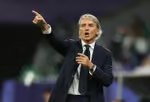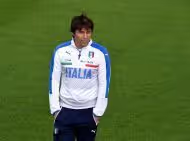
Paolo Maldini and Leonardo have resigned from their newly created roles at the Italian Football Federation, plunging the federation back into a familiar power struggle between Roberto Mancini and Antonio Conte. Their exit — days after announcing an ambitious reform plan and weeks after taking office — follows a stalled coaching recruitment and controversy over a proposed appointment, exposing unclear lines of authority between the technical director role, FIGC president Giovanni Malagò and Serie A clubs.
Maldini and Leonardo quit as FIGC reform flounders
Paolo Maldini and Leonardo stepped down from their positions as technical director and special advisor just 16 days after being appointed and four days after unveiling a joint reform plan. Their swift exit reverses a brief attempt to reshape how Italy appoints and manages its national teams, handing momentum back to established power brokers inside the federation.
What broke down
The pair arrived promising a long-term project to unify the national teams and academy structure. That blueprint faltered amid disagreement over decision-making authority and a recruitment process that produced controversy rather than consensus.
Efforts to bring a marquee name to the Azzurri role — including preliminary contacts with elite managers — failed to yield a clear hire. A later proposal to appoint Andrea Pirlo was derailed by public backlash tied to his commercial affiliations. With no compromise in sight, Maldini and Leonardo chose to walk away rather than preside over a diluted mandate.
Power struggle: president vs. technical director vs. clubs
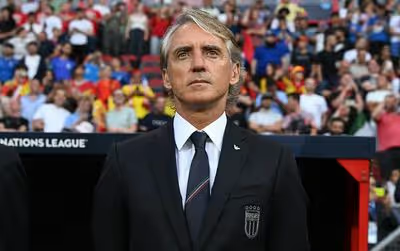
The resignations make plain a governance fault line inside the Italian Football Federation (FIGC). Giovanni Malagò, the FIGC president, appears inclined to restore Roberto Mancini, while Serie A clubs have been pressing for Antonio Conte. The collapsed reform exposed differing visions: a president seeking control, clubs protecting their interests, and an incoming technical director expecting meaningful authority.
This is more than a personnel spat. It’s a contest over who shapes Italy’s footballing identity — short-term results under a high-profile coach or long-term coherence across youth development and the senior team.
Where the candidates stand
Antonio Conte and Roberto Mancini are available and politically viable answers for different constituencies.
Conte offers a combative, detail-driven manager who commands respect in Serie A and among club executives. Mancini brings the continuity of a recent European Championship winner and a softer public profile that appeals to federation leadership looking for stability.
Neither option resolves the structural questions Maldini sought to address: how much say the technical director should have in coaching appointments, and how to align the clubs’ interests with national team development.
Why this matters for the Azzurri
A revolving-door of administrators risks stalling progress on talent pathways and tactical identity. The national team needs clarity well before competitive windows return; protracted infighting undermines planning, scouting and coach selection.
Maldini’s departure is a lost opportunity to professionalize recruitment and bridge the academy-senior team divide. It also signals to coaches and players that FIGC decision-making remains susceptible to external pressures.
Immediate implications and likely next steps
Expect an expedited process to name a head coach, dominated by the same stakeholders who shaped past appointments. The federation will likely prioritize a rapid resolution to restore credibility and prepare for upcoming fixtures.
Longer term, the episode should prompt a hard conversation about governance: if the technical director role is to mean anything, it must come with clearly defined powers and protections from short-term political influence. Otherwise, future reform attempts will face the same fate.
Bottom line
Maldini and Leonardo’s exit returns Italy to familiar terrain: a high-stakes contest between personalities and institutions rather than a decisive move toward structural reform.
Maldini quits after 16 days as federation blocks Pirlo — Italy left searching for direction
The Azzurri enter a period where leadership choices will again be driven as much by federation politics and club pressure as by a coherent sporting vision — and that uncertainty matters for Italy’s prospects on the pitch.
 Football Italia