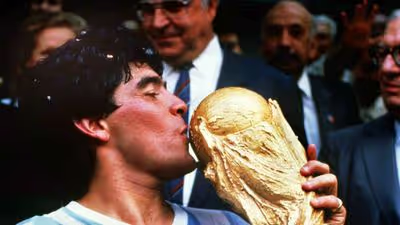
This definitive ranking crowns the 1982 World Cup as the sport’s high-water mark, with 1970, 1986 and 1998 close behind — celebrating the tournaments that produced the biggest moments, deadly goalscorers and tactical revolutions from Pelé and Maradona to Rossi and Messi.
How we judged the greatest World Cups
Memorable goals, headline-making matches, transformational players, and lasting historical impact were the core criteria. Competitiveness, upsets and the tournament’s cultural footprint also tipped the scales when candidates felt otherwise equal.
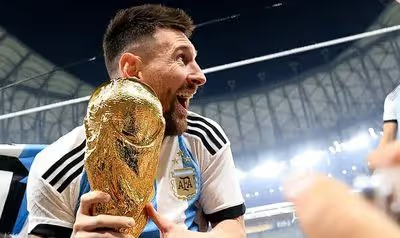
Top 10 World Cups (10–1)
10 — 2022 (Qatar)
Qatar 2022 arrived wrapped in controversy but delivered on the pitch: a record goals haul, Morocco’s seismic run to the semifinals, and Lionel Messi finally sealing the one trophy missing from his résumé. The tournament proved that elite narratives can outshine off-field noise, and that modern football still produces emotional, genuinely global storylines.
9 — 2002 (South Korea/Japan)
A tournament of shocks and spectacle: Ronaldo’s redemption and eight-goal haul for Brazil, South Korea’s improbable semifinal run, and early exits for giants like France and Argentina. 2002 emphasized that tactical astuteness and home advantage can unbalance conventional hierarchies.
8 — 1966 (England)
England’s solitary title, Geoff Hurst’s controversial hat-trick and Eusebio’s nine-goal salvo made 1966 both a national myth and a dramatic global showcase. The event underlined how single moments—debated to this day—can define a tournament’s legacy.
7 — 2026 (North America)
An expanded field and superstar performances made 2026 feel like a reassertion of global depth: Spain ultimately triumphant, tight knockout drama and a high goals-per-game rate. The tournament confirmed the modern World Cup’s capacity to blend entertainment with elite competition.
6 — 1974 (West Germany)
Total Football’s high art met pragmatic German steel. Johan Cruyff’s Netherlands dazzled, but Franz Beckenbauer and Gerd Müller’s efficiency won out. 1974 remains essential for the tactical dialogue it sparked between fluidity and structure.
5 — 2006 (Germany)
A tournament of golden generations and unforgettable drama: Zidane’s final‑match headbutt overshadowed a World Cup rich in quality, with Italy’s defensive mastery and emergent young stars delivering classic matches. 2006 blended nostalgia with contemporary tactical evolution.
4 — 1998 (France)
The first 32-team World Cup amplified global representation and produced enduring moments: Zidane’s final performance, Croatia’s breakout third place and memorable clashes that showcased a broader, more competitive international landscape.
3 — 1986 (Mexico)
Diego Maradona’s tournament, and for good reason. From the “Hand of God” to the solo masterclass against England, Maradona’s genius and controversy defined 1986. The event demonstrated how an individual can lift an entire nation and reshape the World Cup narrative.
2 — 1970 (Mexico)
Aesthetic brilliance and historical milestones: the first color-broadcast World Cup, Pelé’s third title and a Brazil side many regard as the greatest team ever. 1970 married technical artistry with global spectacle, setting an enduring standard.
1 — 1982 (Spain)
1982 is crowned the greatest for its unmatched confluence of star power, drama and underdog triumphs. Debuts from Algeria and Cameroon, the “Night of Seville” France vs. West Germany, and Paolo Rossi’s narrative-altering scoring streak culminated in Italy’s elegant, opportunistic title. It remains the purest distillation of why the World Cup captivates: brilliant teams, unforgettable matches and storylines that still reverberate.
What this ranking means
Great World Cups combine individual brilliance, tactical innovation and social resonance.Tournaments like 1970 and 1982 set stylistic and cultural benchmarks; 1986 and 1998 showcased how singular talents and expanded formats reshape expectations; recent editions prove modern controversies rarely erase on-field drama.
Why it matters for teams and fans
These classics show what national programs chase: balanced squads, tactical identity and a player capable of defining moments.For fans, the best World Cups are signposts—reminders that the tournament’s value lies as much in moments that endure as in the trophies themselves.
Looking ahead
The World Cup will continue evolving—format changes, global expansion and technology will alter the feel—but the fundamentals remain: great matches, iconic players and a few unpredictable shocks.
Those elements are what elevate a tournament from memorable to timeless.
 Si
Si