

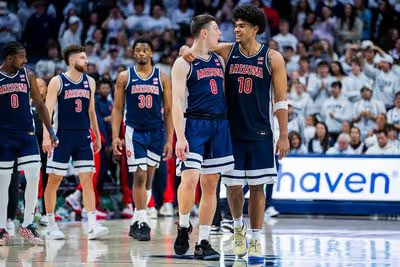
Pivotal Feast Week matchups spotlight teams like Purdue, Arizona and Duke; bettors might lean toward Purdue and Arizona to cover defensive-focused spreads and back under totals in their next games, while Duke’s efficient offense makes them a strong moneyline or points-prop play depending on the opponent.
Feast Week in Las Vegas: Ranked Teams Face Real Tests
Nonconference scheduling has been stronger this season, and Feast Week brings several Top 25 programs into high-profile matchups at the Players Era Festival. Eight ranked teams will converge, with as many as 15 potentially meeting another ranked opponent this week and 11 already locked into such matchups. Some teams that avoided stern competition earlier finally face proper litmus tests.
Power Rankings and Major Storylines
1. Purdue — Defensive Resurgence
Purdue’s defense looks markedly improved from last year. Recent wins at Alabama and over Texas Tech showcased a unit that can take away opponents’ stars and frustrate elite offenses. The Boilermakers used physicality and length inside to limit key scorers and forced poor looks. If the defense sustains this level, Purdue is a realistic national title contender.
2. Arizona — Rebounding and Tactical Discipline
Arizona’s 71-67 win over No. 3 UConn featured a 20-rebound advantage driven by deliberate coaching choices: force midrange shots, protect the rim, and use size to secure missed attempts. UConn’s 25 3-point attempts produced only eight makes, and Arizona limited offensive rebounds. That combination of size, rebounding and scheme makes Arizona strong against teams reliant on second-chance points.
8. Duke — Offense Through the Bigs, Need for a Creator
Duke’s Cameron Boozer has shown elite passing when teams try to double him; the approach often yields high-value possessions rather than turnovers. The Blue Devils remain efficient offensively, playing through their bigs who can pass and finish. The missing element is a consistent off-the-dribble creator. If one emerges, Duke’s offense could become even more dangerous.
9. Alabama — Philon’s Downhill Scoring
Labaron Philon Jr. is proving to be a go-to downhill driver, repeatedly breaking defenses with ball screens and decisive reads. When Philon is in rhythm, Alabama becomes hard to defend late in games. Opponents must pick their coverages carefully; overcommitting to stop him creates open shots for others.
11. BYU — AJ Dybantsa’s Midrange and Foul Drawing
AJ Dybantsa’s midrange game has been effective partly because it draws fouls; his ability to convert and get to the line boosts BYU’s efficiency. The Cougars frequently isolate him in the middle, and teams that double risk fouls or get punished by his passing. Expect BYU to keep designing sets to leverage Dybantsa’s skills.
12. Florida — Frontcourt Strength, Guard Shooting Concerns
Florida’s frontcourt is delivering on expectations, especially on the offensive glass with a 45% offensive rebounding rate. Guard shooting is a work in progress—early 3-point percentages are low—but past slow-start patterns suggest the shooting could normalize, unlocking a potent inside-out offense.
16. Michigan State — Elite Passing and Continuity
Michigan State leads the nation in assist rate, a reflection of roster continuity and elite ball movement. Jeremy Fears Jr. is posting an off-the-charts assist rate; while probably unsustainable, it highlights a team built around creating for teammates. Expect Izzo’s group to remain dangerous in halfcourt sets and transition.
20. Kansas — Depth Tested Without Darryn Peterson
Kansas has shown flashes, but the absence of Darryn Peterson due to a hamstring injury limits pick-and-roll creation. Flory Bidunga has stepped up as a reliable secondary creator and finisher. Peterson’s return should increase KU’s offensive fluidity and scoring frequency.
25. Nebraska — Hoiberg’s Offense and 3-Point Volume
Fred Hoiberg’s Nebraska plays with heavy 3-point volume and efficient two-point execution. Rienk Mast as a playmaking big and shooters like Pryce Sandfort create spacing that leads to high-percentage paint looks. Nebraska’s set play creativity and spacing make them a team that can surprise in tournament settings.
Teams Dropped and Watching
Ohio State was removed from the ranking due to a weaker schedule and inconsistent dominance. Keep an eye on North Carolina State, Ole Miss, Missouri, Iowa, Georgetown, Auburn, Saint Louis, Utah State and Liberty; several are capable of pushing into relevance with strong nonconference showings.
Betting Implications to Monitor
Defense-minded teams like Purdue and Arizona could influence spread and total markets, with under totals more attractive when they control rebounds and limit second-chance points. Offenses that move the ball—Duke and Michigan State—offer moneyline and team-total opportunities. Watch injury timelines (Kansas) and star usage (Philon, Dybantsa) before locking lines.
Conclusion
Feast Week promises significant résumé-building games and clearer pecking orders. Expect guard-driven lineups to be tested by length and disciplined defensive plans, and for bettors to adjust lines as teams prove (or disprove) their early-season narratives.
As many as 15 ranked teams could play another ranked opponent in a week full of neutral-site tournaments and invitationals.
 Theathleticuk


