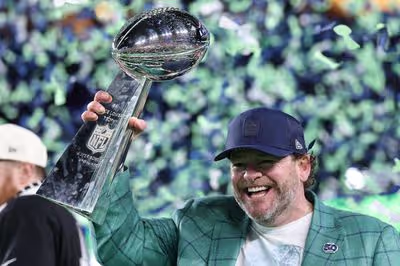
John Schneider’s aggressive roster trades and defensive coach hire push the Seahawks into clear contender status — bettors should consider Seattle in Super Bowl futures and defensive props. New England’s rapid rebuild and Drake Maye make QB and MVP futures attractive long-term plays, but rookie legal issues and owner controversies add volatility, so avoid high-risk rookie props until situations resolve.
John Schneider and the rise of the modern NFL general manager
John Schneider’s Seahawks exemplify a new era: GMs who move fast, swing big and prioritize roster construction over staff or quarterback continuity. Schneider traded Russell Wilson, pivoted coaching hires, and built through aggressive in-season deals and savvy draft picks. The result was a dominant Super Bowl run driven by a defensive-minded head coach and newly assembled contributors.

A blueprint of bold moves
Schneider’s playbook included trading Wilson for premium draft capital, drafting cornerback Devon Witherspoon and offensive star Jaxon Smith-Njigba, and signing disruptive veterans like Leonard Williams and Uchenna Nwosu. He replaced a long-tenured coach with Mike Macdonald, a defensive play-caller who became the first head coach to win a Super Bowl as his team’s primary defensive strategist. Those decisions show how modern GMs convert uncertainty into optionality.
Why defensive construction matters
Seattle’s Super Bowl victory underlined a simple truth: a lockdown defense can neutralize offensive uncertainty. The Seahawks committed to personnel who fit Macdonald’s scheme, collected impact defenders midseason, and turned turnover opportunities into game-clinching plays. That approach reduced reliance on quarterback heroics and let a conservative offensive game plan succeed in big moments.
How the Eagles and other GMs compare
The Eagles’ Howie Roseman follows a similar aggressive template, having traded Carson Wentz years ago and won with Jalen Hurts. Not every GM pushes the envelope like Schneider or Roseman, but the upside for those who do is now clearer: championships with different coaches and roster iterations. This model elevates front-office decision-making as the league’s most influential role.
Patriots’ rapid rebuild and Drake Maye’s rise
New England’s climb from 4-13 to a Super Bowl appearance after massive roster turnover is one of the most extreme turnarounds in modern NFL history. The Patriots led all notable outliers in percentage of new players, starts by new players and Approximate Value produced by newcomers. Heavy free-agent spending and a first-year head coach created a balanced, non–star-driven roster that prospered quickly.
What separates New England from other rebounds
Where other turnaround teams mixed youth and continuity, the Patriots replaced much of their economic core in one offseason. Their top free-agent signings consumed a large portion of cap space, a gamble that accelerated results. Drake Maye’s efficiency and statistical edge over some peers made him a compelling regular-season MVP candidate on ballots submitted before the playoffs, despite debates about postseason impact.
MVP debate and awards timing
Ballots due before the playoffs skew award outcomes toward regular-season performance. That timing contributed to split opinions between Matt Stafford, who shined in the playoffs, and Drake Maye, who posted superior per-play metrics during the regular season while operating with less surrounding talent. The awards conversation continues to factor both raw production and team context.
Hall of Fame selection tensions
Recent voting controversies highlighted conflicting priorities on the selection committee: long-waiting senior candidates versus more recently retired, high-impact figures. Calls to reshuffle committee composition and emphasize objectivity have grown louder after close, contentious results. The process is under scrutiny as larger classes and stacked ballots loom in coming years.
Obituaries and historical context
The article reflects on the passing of important football figures who bridged playing and broadcasting careers, celebrating their unique contributions to the game and the cultural footprint they left beyond the field.
Off-field controversies affecting team narratives
Legal and personal matters continue to influence roster and reputation risk. James Pearce, a high-profile rookie, faces serious legal charges that could derail his career and the Falcons’ investment. Separately, past communications linking a team owner to controversial figures have prompted league review into conduct detrimental to the game. These situations create roster uncertainty and potential league sanctions, complicating franchise planning.
Coaching churn, staff departures and market implications
Veteran coaches and assistants still hold leverage. Names like Jim Schwartz and Jeff Stoutland illustrate how coordinators can walk away when roles shrink or alignment fails. Coaching hires and staff autonomy remain major competitive levers; teams that manage those dynamics well sustain continuity while others risk internal attrition.
Quarterback market and veteran movement
Quarterback availability is heating up. Derek Carr’s hinted return to play could reshape 2026 quarterback valuations and create trade opportunities. Backup quarterbacks like Mac Jones and Davis Mills are worth watching as affordable, serviceable options if teams need short-term stability.
On-field takeaways and postseason execution
Seattle’s playoff streak of zero turnovers and a defense that held New England to minimal yardage in the Super Bowl showed the value of limiting mistakes in postseason football. Even quarterbacks with turnover-prone regular seasons can succeed when a defense forces the script.
What this means for bettors and roster watchers
Team construction — not just star players — increasingly dictates favorites and market adjustments. Aggressive GMs who prioritize fit, midseason trades and defensive identity create sustainable betting narratives. Conversely, off-field volatility and rookie legal issues can make player-specific and rookie prop markets risky until situations clear.
Conclusion
The NFL’s balance of power has shifted toward front offices willing to take calculated risks. Between Schneider’s model, New England’s accelerated rebuild and a restless coaching market, the league’s next decade will reward organizations that blend bold roster moves with disciplined evaluation.
Sam Darnold slips again in NFL quarterback power rankings after another dud
Great QBs have ruled the NFL for decades, but increasingly, even they are living in a league driven by the active, opportunistic GM.
 Theathleticuk